Tutorial 27 · Factions and economy
Earning crowns: what to sell at each tier
In Rustfall, you earn crowns by selling the network the 37 items in its catalogue, by hand with `/sell` or around the clock with a freight quay. What pays best changes with each age: ingots in the age of coal (2.50 crowns base for iron), steel in the age of steam (7 crowns), circuits in the age of oil (16 crowns for a Logic Circuit, 47.50 for an Engineering Circuit), then storage components and Fuel Rods (130 crowns). An item's price falls when the network sells a lot of it: the greater its depth, the more sales it takes before dropping.
- Intermediate
- 12 steps
- 7 blocks in the 3D scene
- Factions and economy
What you need
Building the scene…
- Step 1 of 12
Reading a table: base, depth, cap
The network buys a fixed list of items, the catalogue, at a price shared by every server. Each item has three figures. Its base: what it is worth when nobody has sold any recently. Its depth: the number of recent sales that cuts its price in half. Its cap: the most it can bring in per hour, for all players together.
WhyAn item with a large depth sells by the chestful at almost base price. An item with a small depth drops from the very first sales: better to sell a few at a time, or to another player.
- Iron ingot
- 2.50 crowns · depth 402,512
- Diamond
- 25 crowns · depth 7,791
- Molten Core
- 300 crowns · depth 39
Place at this step
TipThe same figures, for the whole catalogue, are on the Economy page. In game, the Counter shows the current price and its 24-hour chart.
- Step 2 of 12
Age of coal: sell ingots, not ore
At the start, you sell what you mine. Do not sell raw ore: crushed and then smelted, one ore gives two ingots, and an ingot is worth more than the raw item. A raw iron is worth 1 crown; its two ingots are worth 5. The iron ingot is also the deepest item in the whole catalogue: you can sell chests of it without moving its price.
WhyRaw items have a small depth (19,476 for raw iron, against 402,512 for the ingot): they are in the catalogue for the miner with no machine, not for a factory. Diamonds and emeralds pay well apiece, but they are rare and their depth is small.
- Raw iron
- 1 crown · depth 19,476 · cap 2,250 crowns/h
- Iron ingot
- 2.50 crowns · depth 454,449 · cap 131,250 crowns/h
- Raw copper
- 0.50 crowns · depth 12,984 · cap 750 crowns/h
- Copper ingot
- 1.25 crowns · depth 166,198 · cap 24,000 crowns/h
- Raw Tin
- 0.80 crowns · depth 6,492 · cap 600 crowns/h
- Tin Ingot
- 2 crowns · depth 25,969 · cap 6,000 crowns/h
- Raw gold
- 2.50 crowns · depth 6,492 · cap 1,875 crowns/h
- Gold ingot
- 6 crowns · depth 38,953 · cap 27,000 crowns/h
- Coal
- 0.75 crowns · depth 25,969 · cap 2,250 crowns/h
- Redstone Dust
- 0.50 crowns · depth 103,874 · cap 6,000 crowns/h
- Lapis lazuli
- 0.75 crowns · depth 25,969 · cap 2,250 crowns/h
- Nether Quartz
- 1.25 crowns · depth 51,937 · cap 7,500 crowns/h
- Emerald
- 15 crowns · depth 3,895 · cap 6,750 crowns/h
- Diamond
- 25 crowns · depth 7,791 · cap 22,501 crowns/h
TipYour first ingots and your first sale are in your first day in Rustfall; the line that makes them on its own is in the ingot farm.
- Step 3 of 12
Age of steam: steel and bronze
The Alloy Smelter adds value to what you were already selling. 1 iron and 2 coal (4 crowns of materials at base price) give 1 Steel Ingot at 7 crowns. 3 copper and 1 tin (5.75 crowns of materials) give 4 Bronze Ingots, 8 crowns in all.
WhyThe Steel Ingot has the highest cap in the catalogue: it is the item the network can absorb the most of, in value. As long as you have iron and coal, steel is the safe sale.
- Bronze Ingot
- 2 crowns · depth 142,827 · cap 33,000 crowns/h
- Steel Ingot
- 7 crowns · depth 296,690 · cap 239,925 crowns/h
TipThe recipes and the machine are in alloys.
- Step 4 of 12
Tier 2, the workshop: tempered steel, white brass, motors
The arc furnace casts two alloys that sell: 4 steel and 2 quartz give 4 tempered steel ingots (9.50 crowns each), 3 bronze and 1 tin give 4 white brass ingots (3 crowns each). The assembler makes the electric motor, 12 crowns.
WhyTheir depth is far smaller than steel's (19,476 against 296,690): they are a side income, not something to sell by the chestful. Plates and wires do not sell: that would be selling the same ingot twice.
- White brass ingot
- 3 crowns · depth 19,476 · cap 6,750 crowns/h
- Tempered steel ingot
- 9.50 crowns · depth 19,476 · cap 21,375 crowns/h
- Electric motor
- 12 crowns · depth 3,895 · cap 5,400 crowns/h
TipThe build is in tier 2: the workshop.
- Step 5 of 12
Age of oil: plastic and circuits
The refinery turns out Plastic (4 crowns), and the circuit assembler makes three circuits from it: with gold, the Logic Circuit (16 crowns); with quartz, the Calculation Circuit (13 crowns); with a diamond, the Engineering Circuit (47.50 crowns).
WhyThe Logic Circuit has the second-highest cap in the catalogue, right behind steel, and a large depth: it is the mass product of this age. The Engineering Circuit is worth nearly three times as much apiece, but drops faster (depth 16,880).
- Plastic
- 4 crowns · depth 71,413 · cap 33,000 crowns/h
- Calculation Circuit
- 13 crowns · depth 45,445 · cap 68,250 crowns/h
- Logic Circuit
- 16 crowns · depth 114,911 · cap 212,401 crowns/h
- Engineering Circuit
- 47.50 crowns · depth 16,880 · cap 92,628 crowns/h
TipFrom crude to circuit: oil.
- Step 6 of 12
Computing and nuclear: components and rods
Storage components sell for 35 crowns (1k) and 120 crowns (4k). On the nuclear side, value rises with each machine: 4 Uranium Dust (14 crowns) make 1 Enriched Uranium at 22.50 crowns, and 3 Enriched Uranium and 6 steel (109.50 crowns of materials) make 1 Fuel Rod at 130 crowns.
WhyThese are the most expensive items a factory produces, but their depths are small (1,298 for the 4k component, 1,558 for the rod). The real wealth of these two ages lies elsewhere: power and autocrafting, which keep the steel and circuit lines running.
- 1k Storage Component
- 35 crowns · depth 8,570 · cap 34,652 crowns/h
- 4k Storage Component
- 120 crowns · depth 1,298 · cap 17,994 crowns/h
- Uranium Dust
- 3.50 crowns · depth 2,597 · cap 1,050 crowns/h
- Raw Uranium
- 6 crowns · depth 2,597 · cap 1,800 crowns/h
- Enriched Uranium
- 22.50 crowns · depth 3,765 · cap 9,786 crowns/h
- Fuel Rod
- 130 crowns · depth 1,558 · cap 23,398 crowns/h
Common mistakeSelling all your Fuel Rods: one rod runs a reactor for 30 minutes at full power. Sell the surplus, not your plant's fuel.
- Step 7 of 12
Outrefaille: loot sells, but at a floor price
The network also buys loot from automatons and bosses. It is a floor price: what a player gets when they cannot find a buyer. This loot is first meant for crafting (upgrades, Colossal Alloy, superconductor cables, the Containment set, the fusion chamber) and is sold between players at the auction house.
WhyThe depths are tiny: the price falls from the very first piece. Worked out with the price formula, on a market at rest: 64 Automaton Servos bring 607 crowns rather than 640; one Stable Core, 2,772 crowns rather than 4,000.
- Automaton Servo
- 10 crowns · depth 584 · cap 675 crowns/h
- Colossus Plate
- 15 crowns · depth 876 · cap 1,518 crowns/h
- Magnetized Scrap
- 24 crowns · depth 623 · cap 1,727 crowns/h
- Containment Plate
- 60 crowns · depth 90 · cap 624 crowns/h
- Molten Core
- 300 crowns · depth 39 · cap 1,352 crowns/h
- Magnet Core
- 450 crowns · depth 21 · cap 1,092 crowns/h
- Reactor Core
- 900 crowns · depth 5 · cap 520 crowns/h
- Stable Core
- 4000 crowns · depth 1 · cap 462 crowns/h
Common mistakeDumping a whole group's loot on the network in one go. The Scrapper's Talisman, for its part, cannot be sold to the network.
TipWhere this loot comes from: the rusted automatons, the Foreman and the Outrefaille.
- Step 8 of 12
Understanding why a price falls
An item's price is B / (1 + P / K): B its base, K its depth, P the pressure, meaning the recent sales of the whole network. Pressure halves every 6 hours: the price climbs back on its own when selling stops. Selling in ten small batches or in one big one brings the same amount.
WhyThe figures for the reference factories show it. A coal-age factory sells 700 iron ingots, 300 copper ingots and 200 coal in an hour: 2,275 crowns at base price. Alone on the network, it keeps 2,242. With ten identical factories at the same time, 1,982; with fifty, 1,307.
- Price
- B / (1 + P / K)
- Pressure half-life
- 6 hours
- Coal-age factory, at base price
- 2,275 crowns/h
- Alone on the network
- 2,242 crowns/h
- Ten identical factories
- 1,982 crowns/h each
- Fifty identical factories
- 1,307 crowns/h each
TipThe rule of thumb: sell several products rather than one, and wait for the pressure to drop. The details are in understanding the economy.
- Step 9 of 12
Selling by hand: /sell
`/sell` opens a three-row box: drop in what you are selling, the golden button tells you what it will bring and sells everything in one click. `/sell hand` sells what you are holding, `/sell all` empties your bag except the hotbar. The book in the box opens the Counter: prices, their 24-hour chart, and what the quantity you pick will bring.
WhyAnything without a price comes back to your bag, as does whatever is left in the box when you close it. The total of a sale is rounded down to the crown.
Common mistakeSelling items worth less than a crown one at a time (raw copper, redstone, coal): the fractions of a crown are lost on every sale. Sell them by the stack.
- Step 10 of 12
Selling around the clock: the freight quay and its threshold
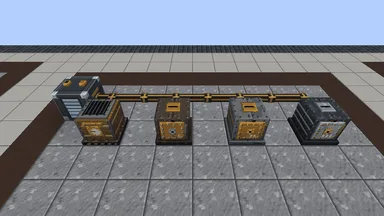
The freight quay sells on its own. Give it power, load it with a hopper, an Item Conduit or by hand: every five seconds, it ships what it holds to the network, at the current price. In its window, the “Not below” setting sets a threshold: never, 50% or 70% of the base.
WhyBelow the threshold, the quay keeps what it holds: your factory stockpiles instead of selling cheap, and sells once the price has recovered. Anything without a price comes back out through its three output slots.
- Inputs / outputs
- 9 / 3
- Power draw
- 40 RC/s
- Pace
- one shipment every 5 s
- Thresholds
- never, 50%, 70% of the base
Place at this step
 Combustion Generator
 Copper Cable
 Hopper
 Chest
TipThe step-by-step build, with the return chest, is in automatic selling.
- Step 11 of 12
Keeping crowns safe: the crown vault
The quay window also sets where the crowns go: to whoever placed it, to their guild's bank, or to a crown vault on the same power network. Right-clicking the vault shows its balance and the “Collect” button, which pays everything to the player who placed the vault, and no one else.
WhyA full vault stops the selling: the quay shows “Crown vault full” and keeps its stock, and no crown earned is lost. Broken, the vault keeps its crowns inside the item.
- Crown vault
- 1,000,000 crowns
- Crown vault T2
- 10,000,000 crowns
- Crown vault T3
- 100,000,000 crowns
Place at this step
Common mistakePlacing the vault on a different power network from the quay: the quay shows “No crown vault on its network”.
TipEverything about this block: the crown vault, your base's bank.
- Step 12 of 12
Knowing what does not sell
The network only buys its catalogue. Left out on purpose: anything that grows or drops endlessly from a farm (wood, charcoal, crops, loot from Minecraft mobs, cobblestone and whatever is crushed from it) and machines, which players sell to each other. Tier 2 plates and wires are not in it either.
WhyEven in the catalogue, an item that is named, enchanted, damaged or charged does not go: only items without components are sold. All of that goes through the auction house, which takes a 5% tax on the price and a deposit of 1% of the asking price.
- Auction house tax
- 5% of the price, at least 1 crown
- Auction house deposit
- 1% of the asking price, at least 1 crown
Common mistakeBuying from the Counter to sell back: the network sells its materials at twice their base at least, so you lose every time.
What you end up with
You know what to sell at each age and in what quantity, why a price falls, and how to sell by hand, around the clock with a threshold, and into a crown vault.
In the in-game demo
These builds exist for real in Rustfall’s “Demo & help” world (the game’s Esc menu): every stand runs, and its sign says what it does. Here are those signs, as written in the game.
Frequently asked questions
What should I sell to earn crowns in Rustfall?
Items from the network's catalogue, processed rather than raw: iron ingots (2.50 crowns base) and copper ingots in the age of coal, Steel Ingots (7 crowns) in the age of steam, Logic Circuits (16 crowns) in the age of oil, then storage components and Fuel Rods (130 crowns). You are better off selling several products than a single one.
Which item sells best in bulk?
The Steel Ingot has the highest cap in the catalogue (239,925 crowns per hour for the whole network), ahead of the Logic Circuit (212,401) and the iron ingot (116,250). The iron ingot has the greatest depth: 402,512.
Why does the price fall when I sell?
The price is B / (1 + P / K): every sale, across the whole network, adds to the pressure P. K recent sales cut the price in half. Pressure halves every 6 hours, and the price climbs back on its own.
Should I sell boss loot to the network?
As a last resort. The network buys it at a floor price and the depths are very small (39 for the Molten Core, 1 for the Stable Core): the price drops from the very first piece. This loot is first meant for recipes and is sold between players at the auction house.
What does the network not buy?
Wood, charcoal, crops, loot from Minecraft mobs, cobblestone and whatever is crushed from it, machines, plates and wires. A named, enchanted, damaged or charged item does not go either.
Related blocks and items
 Freight quay
 Crown vault
 Crown vault T2
 Crown vault T3
 Tin Ingot
 Bronze Ingot
 Steel Ingot
 Tempered steel ingot
 White brass ingot
 Electric motor
 Plastic
 Logic Circuit
 Calculation Circuit
 Engineering Circuit
 1k Storage Component
 4k Storage Component
 Enriched Uranium
 Fuel Rod
 Automaton Servo
 Colossus Plate
 Magnetized Scrap
What’s next
- Tutorial 17
Understanding the economy
The Rustfall economy: crowns, selling to the network, the price B / (1 + P / K), the cap on each item, freight quay thresholds and money sinks.
- Tutorial 08
Automatic selling: freight quay
Sell without lifting a finger in Rustfall: the freight quay ships your ingots to the network every 5 seconds, and the crown vault keeps what they earn.
- Tutorial 22
The crown vault
Rustfall's crown vault keeps what your freight quay earns: 1, 10 or 100 million crowns depending on the tier, a “Collect” button and a comparator reading.
- Tutorial 26
Your first day in Rustfall
How to get started in Rustfall: tin, the hand-cranked crusher, first ingots, a generator, the alloy smelter, then /sell and your first crown. Eight steps.