Tutorial 09 · The age of oil
Oil: oil well, refinery, plastic and circuits
In Rustfall, oil is pumped from a deposit by an oil well (a 3 × 3 × 3 structure, 50 mB/s of crude for 250 RC/s), then refined into diesel, kerosene and plastic in an oil refinery (100 mB/s of crude, 400 RC/s). Diesel burns in a diesel generator (up to 600 RC/s), but the chain spends slightly more power than it gives back: you drill for the plastic, which, run through the circuit assembler with gold, quartz or a diamond, gives the three circuits that open up the data network.
- Intermediate
- 8 steps
- 24 blocks in the 3D scene
- The age of oil
What you need
Building the scene…
- Step 1 of 8
Find the deposit
Hold the oil detector and right-click: it tells you the crude beneath you, or the richest deposit within eight chunks. At the centre of the richest chunk of every field, an oil spring smokes in the middle of a crude seep: that is where the oil well goes.
WhyOil is a property of the chunk, derived from the world seed: one 4 × 4 chunk field out of four has some. What has been pumped is recorded on the chunk, and the deposit eventually runs dry.
- Oil fields
- 1 field of 4 × 4 chunks out of 4
- Crude per chunk
- 100,000 to 2,000,000 mB
- Detector range
- 8 chunks
Place at this step
Common mistakePlacing the oil well at random: outside a field the chunk has no crude and the structure pumps nothing.
- Step 2 of 8
Place the oil well
Place the oil well on the deposit. The 3 × 3 × 3 structure goes down in one go, around its centre block: it needs 27 free blocks. It pumps the crude from its chunk's deposit until it is depleted.
WhyThe oil well is a single model carried by the centre block; the 26 other blocks of the structure are invisible and point back to it. Its crude ports are marked on the model, at the foot of three of its faces.
- Flow
- 50 mB/s of crude
- Power draw
- 250 RC/s
- Output tank
- 16,000 mB
Place at this step
Recipes
 2Steel FrameOpen its page ›
Steel Frame × 2 In the assembler: 4 × Steel plate, 2 × Bronze plate (makes 2).
Common mistakeA stray block inside the 3 × 3 × 3 volume: the structure refuses to be placed until the space is clear.
- Step 3 of 8
Place the refinery
A few blocks away, place the oil refinery: another 3 × 3 × 3 structure placed in one go. It turns crude into diesel, kerosene and plastic (plastic comes out in its output slot, as an item).
- Flow
- 100 mB/s of crude
- Power draw
- 400 RC/s
- Tanks
- 16,000 mB of crude, 8,000 mB of diesel, 8,000 mB of kerosene
Place at this step
TipThe refinery swallows twice what one oil well pumps: two wells keep it running flat out.
- Step 4 of 8
Power both structures
Put a Battery T2 against the foot of the oil well and run a gold cable to the refinery. Connect this network to your power plant: the well and the refinery ask for 650 RC/s between them.
WhyA network's throughput is that of its weakest cable: copper cable tops out at 250 RC/s, gold cable at 1,000 RC/s. With no cable at all (machines touching), a network only has the throughput of copper.
- Oil well + refinery
- 250 + 400 = 650 RC/s
- Gold cable
- 1,000 RC/s
- Battery T2
- 250,000 RC, 1,000 RC/s
Place at this step
Common mistakeKeeping the copper cable from the coal age: at 250 RC/s the refinery shows “Not enough power”.
- Step 5 of 8
Bring the crude to the refinery
Start from the oil well's crude port with steel pipes and reach the refinery's crude port, at the foot of its face marked for crude. The well runs as soon as it has power: without a pipe, it fills its 16,000 mB tank, then stops (“Output full”).
WhyPipes form networks just like cables, but a network carries only one fluid at a time, chosen by whatever produces it: this pipe will only ever carry crude.
- Steel pipe
- 8,000 mB/s
- Copper pipe
- 1,000 mB/s
Place at this step
Common mistakeConnecting the crude pipe to the diesel or kerosene port: each refinery port has its own fluid, so read the markings on the model.
- Step 6 of 8
Burn the diesel
On the diesel port, place a piece of steel pipe and then a diesel generator, touching the power network. It burns diesel (and kerosene) and gives the network back a good share of the power spent. Oil does not pay for itself: keep another power source next to it.
WhyThe point of oil is not the power: it is plastic, circuits, and a fuel that can be stored in tanks and carried around, to have power where there is neither coal nor steam. Like the combustion generator, the diesel generator only burns when the power has somewhere to go: on a saturated network it stops and keeps its fuel.
- Output
- up to 600 RC/s (300 RC/s on the diesel of a single well)
- Spent per mB of crude
- 5 RC at the well + 4 RC at the refinery = 9 RC
- Returned per mB of crude
- 0.5 mB of diesel × 12 + 0.3 mB of kerosene × 9 = 8.7 RC
- Diesel
- 12 RC per mB
- Kerosene
- 9 RC per mB
- Tank
- 8,000 mB
Place at this step
Common mistakeCounting on the diesel generator to run the well and the refinery on its own: even burning all the diesel and all the kerosene, it falls 0.3 RC short per mB of crude.
- Step 7 of 8
Store the kerosene
On the kerosene port, place a piece of pipe and then two tanks, one on top of the other: touching, they form a single 64,000 mB vessel. The kerosene waits there, for a second diesel generator for instance.
WhyA port does not fill a tank placed directly against it: you need a piece of pipe in between. When one of the refinery's outputs is full, it stops and says so (“Output full”).
- Tank
- 32,000 mB, one fluid at a time
Place at this step
Common mistakeLeaving the kerosene with nowhere to go: once its 8,000 mB tank is full the refinery stops, and the diesel with it.
- Step 8 of 8
Assemble the circuits
Connect a circuit assembler to the network and give it the refinery's plastic, some metal and redstone. With gold it makes a logic circuit; with quartz, a calculation circuit; with a diamond, an engineering circuit.
WhyCircuits go into the whole data network (controller, terminals, network intakes and dispensers, disks) and the nuclear machines. They also sell to the network: 16, 13 and 47.50 crowns base price.
- Power draw
- 200 RC/s
- Time
- 5 s per circuit
- Upgrades
- 2 slots (speed, efficiency)
Place at this step
TipAn item conduit between the refinery and the assembler delivers the plastic by itself: see logistics.
 4
 2
What you end up with
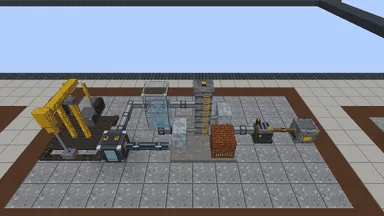
A complete oil field: the oil well pumps 50 mB/s of crude, the refinery returns diesel, kerosene and plastic, the diesel generator gives the network back a good share of the power spent (up to 600 RC/s) and the assembler turns out all three circuits.
In the in-game demo
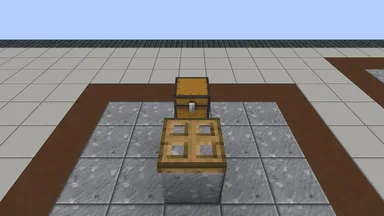
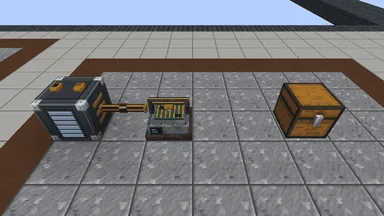
These builds exist for real in Rustfall’s “Demo & help” world (the game’s Esc menu): every stand runs, and its sign says what it does. Here are those signs, as written in the game.
Frequently asked questions
Where do you find oil in Rustfall?
One 4 × 4 chunk field out of four holds oil, from 100,000 to 2,000,000 mB per chunk. The oil detector reports the crude beneath you or the richest deposit within eight chunks, and a smoking oil spring marks the centre of the richest chunk of each field.
How much does an oil well produce?
An oil well pumps 50 mB/s of crude from its chunk's deposit and draws 250 RC/s. It stops once the chunk's deposit is depleted.
What does the refinery make?
The oil refinery turns 100 mB/s of crude into diesel, kerosene and plastic, for 400 RC/s. Diesel and kerosene leave through ports marked on the model, plastic through its output slot.
How do you make circuits?
In the circuit assembler (200 RC/s, 5 s), with plastic, redstone and a material: gold for a logic circuit, quartz for a calculation circuit, a diamond for an engineering circuit.
Related blocks and items
 Oil detector
 Oil Spring
 Crude Seep
 Oil well
 Oil refinery
 Steel Pipe
 Copper Pipe
 Tank
 Diesel Generator
 Circuit Assembler
 Plastic
 Logic Circuit
 Calculation Circuit
 Engineering Circuit
 Gold Cable
 Battery T2
- Steel Frame
What’s next
- Tutorial 10
The data network
Rustfall's data network: network controller, 16- and 64-channel cables, drive bay, terminal, intake, dispenser and chest reader, P2P tunnels and wireless.
- Tutorial 08
Automatic selling: freight quay
Sell without lifting a finger in Rustfall: the freight quay ships your ingots to the network every 5 seconds, and the crown vault keeps what they earn.
- Tutorial 13
Equipment
Rustfall's electric equipment: eyes, back and belt slots, chargers T1 to T3, belt battery, jetpack and dash, battery-powered drill and chainsaw.