Tutorial 21 · Tier 2: the workshop
Arms and conveyor belts: a line that runs itself
At tier 2, logistics is something you can see. The robot arm takes from the inventory behind it and places into the one in front of it: 16 items per second for 20 RC/s. The belt drive does the same, but delivers at the end of its line of conveyor belts (48 at most, turns included), for 40 RC/s. From a machine, they only take outputs. This tutorial builds a whole line: ore, industrial crusher, induction furnace, ingots.
- Advanced
- 7 steps
- 16 blocks in the 3D scene
- Tier 2: the workshop
What you need
Building the scene…
- Step 1 of 7
Start from the two machines of the tier 2 farm
Place a chest for the ore, then, leaving one free block between each block, an industrial crusher and an induction furnace. Run a Gold Cable behind the whole line, from your power plant or a Battery T2.
WhyThe free blocks are for the arms: an arm takes up a full block, between the inventory it takes from and the one it places into. The cable runs behind because arms, machines and belt drive all connect to whatever touches them.
- Industrial crusher
- 1 ore → 3 dusts, 2 s, 400 RC/s
- Induction furnace
- 1 smelt per second, 300 RC/s
- Gold Cable
- 1,000 RC/s
Place at this step
TipThese two machines are built step by step in the tier 2 ingot farm, with Item Conduits. Here, arms replace them.
- Step 2 of 7
Assemble the arms and place the first
In the assembler, 2 electric motors, 2 steel plates, 4 copper wires and 1 Hopper make two robot arms. Place the first between the chest and the crusher, facing the crusher.
WhyAn arm takes from the inventory behind it and places into the one in front of it. You can watch it work: the boom swings from back to front with the item in its gripper. The gripper is only a picture: the item leaves its source only if it fits into its destination.
- Throughput
- 16 items per second
- Power draw
- 20 RC/s
- Internal storage
- 1,000 RC
- Recipe (assembler)
- 2 electric motors, 2 steel plates, 4 copper wires, 1 Hopper → 2 arms
Place at this step
Recipes
 2Electric motorOpen its page ›
 2Steel plateOpen its page ›
 4Copper wireOpen its page ›
 HopperMinecraft item
 2Robot armOpen its page ›
Robot arm × 2 In the assembler: 2 × Electric motor, 2 × Steel plate, 4 × Copper wire, 1 × Hopper (makes 2).
Electric motorOpen its page ›Electric motor In the assembler: 4 × Copper wire, 2 × Iron plate, 1 × Copper Coil.
Common mistakeAn arm placed the wrong way round between a chest and a machine says nothing: it works in the other direction and empties the machine into the chest. It only shows "Nothing behind it to take from" or "Nothing in front of it to place into" when an inventory is missing on one side. One click of the Wrench turns it.
- Step 3 of 7
Place the second arm, from crusher to furnace
Place the second arm between the industrial crusher and the induction furnace, facing the furnace: it takes the dusts out of the crusher and feeds them in to be smelted.
WhyFrom a machine, an arm only takes outputs; into a machine, it only places what the machine accepts. So the ore waiting in the crusher is never carried off, and nothing useless goes into the furnace.
- Takes
- the outputs of the machine behind it
- Places
- what the inventory in front of it accepts
Place at this step
- Step 4 of 7
Place the belt drive against the furnace
In the assembler: 1 electric motor, 2 steel plates, 2 copper wires and 1 Hopper make a belt drive. Place it against the induction furnace, facing where the line will go.
WhyThe drive does the job of an arm, but delivers at the end of its line of belts instead of placing in front of itself. Like the arm, it goes against whatever it should empty.
- Throughput
- 16 items per second
- Power draw
- 40 RC/s
- Internal storage
- 2,000 RC
- Recipe (assembler)
- 1 electric motor, 2 steel plates, 2 copper wires, 1 Hopper
Place at this step
Recipes
Electric motorOpen its page ›2Steel plateOpen its page ›2Copper wireOpen its page ›HopperMinecraft item Belt driveOpen its page ›
Belt drive In the assembler: 1 × Electric motor, 2 × Steel plate, 2 × Copper wire, 1 × Hopper.
- Step 5 of 7
Trace the belt line to the output chest
In the assembler, 3 iron plates and 4 Dried Kelp make eight conveyor belts. Place them in front of the drive, one after another: each belt carries the way you are looking when you place it. Here, one straight belt, then a turn and a last belt, up to the ingot chest.
WhyBelts are only a path: they hold no stock. What you see gliding along the belt is a picture; the item goes from the furnace to the output chest in one move. Nothing falls off and nothing is lost, and breaking a belt stops the line without dropping anything.
- Length
- 48 belts at most, turns included
- Recipe (assembler)
- 3 iron plates, 4 Dried Kelp → 8 belts
Place at this step
 Conveyor belt ×3
 Chest
Recipes
 3Iron plateOpen its page ›
 4Dried kelpMinecraft item8Conveyor beltOpen its page ›
Conveyor belt × 8 In the assembler: 3 × Iron plate, 4 × Dried kelp (makes 8).
Common mistakeA belt turned the wrong way, or a line ending in thin air: the drive shows "The line leads to no inventory" and moves nothing.
- Step 6 of 7
Add ore and watch the line run
Fill the ore chest. The first arm feeds the crusher, the second carries the dusts to the furnace, and the belt drive takes the ingots to the output chest.
WhyEverything stops when what follows is full and starts again by itself: an arm sleeps when it has nothing to move and wakes when one of its two inventories changes.
- Two arms
- 2 × 20 RC/s
- Belt drive
- 40 RC/s
- Crusher + furnace
- 400 + 300 RC/s
- Whole line
- 780 RC/s (total)
Common mistakeOn a Copper Cable (250 RC/s), the line runs short of power: the machines show "Not enough power". It takes a Gold Cable.
- Step 7 of 7
Sort with sorting templates
The window of an arm or a belt drive has three "Sorting template" slots. Put one copy of an item in a slot: from then on it only moves those items. All three slots empty: everything goes through.
WhyThis is the tier 2 filter: a chest of mixed iron and copper can feed two lines, each with its own template.
- Sorting slots
- 3 per arm and per belt drive
- No template
- everything goes through
TipFor finer filters (blacklist, priorities, round-robin), Item Conduits are still there.

What you end up with
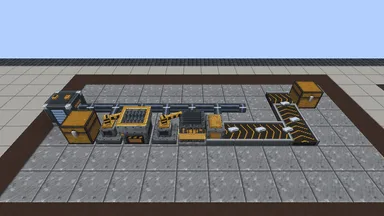
A line that runs itself, in plain sight: the ore leaves the chest, goes through the industrial crusher and the induction furnace, and the ingots glide along the belts to the output chest. Connect that chest to a freight quay and the line sells itself.
In the in-game demo
These builds exist for real in Rustfall’s “Demo & help” world (the game’s Esc menu): every stand runs, and its sign says what it does. Here are those signs, as written in the game.
Frequently asked questions
Which way should a robot arm face?
Towards the inventory it should place into: it takes from the one behind it and places into the one in front of it. The wrong way round between two inventories, it works in the other direction without a word. When an inventory is missing on one side, it shows "Nothing behind it to take from" or "Nothing in front of it to place into".
How many conveyor belts can one belt drive run?
48 at most, turns included. Each belt must face the way it carries, and the line must end against an inventory.
Can items fall off the belt?
No. Belts are only a path, with no stock: what you see gliding along is a picture. The item leaves its source only if it fits into its destination; breaking a belt stops the line without dropping anything.
How do you sort with an arm or a belt drive?
With its three "Sorting template" slots: put in one copy, and it only moves those items. With no template, everything goes through.
Related blocks and items
- Robot arm
- Belt drive
- Conveyor belt
 Industrial crusher
 Induction furnace
 Assembler
- Electric motor
- Steel plate
- Iron plate
- Copper wire
 Gold Cable
 Battery T2
 Item Conduit
What’s next
- Tutorial 19
Tier 2 ingot farm
Rebuild your ingot farm at Rustfall's tier 2: industrial crusher (3 dusts per ore, 2 s) and induction furnace (smelts in 1 s). Half as many ingots again.
- Tutorial 18
Tier 2: the workshop
Build Rustfall's tier 2 workshop: rolling mill (plates), wire mill (wires), assembler and arc furnace as 3 × 3 × 3 structures, tempered steel, white brass.
- Tutorial 08
Automatic selling: freight quay
Sell without lifting a finger in Rustfall: the freight quay ships your ingots to the network every 5 seconds, and the crown vault keeps what they earn.